
Write the acceptance question first
Identify the current limitation and the measurement that will determine improvement. Lower purchase price, better capture and higher throughput are different objectives; specify the trade-off before ranking candidates.
Document the baseline product, feed condition, equipment and current consumption. State dose units clearly. If the baseline is unstable, establish why before relying on a single comparison as evidence for replacement.
Keep the screening conditions controlled
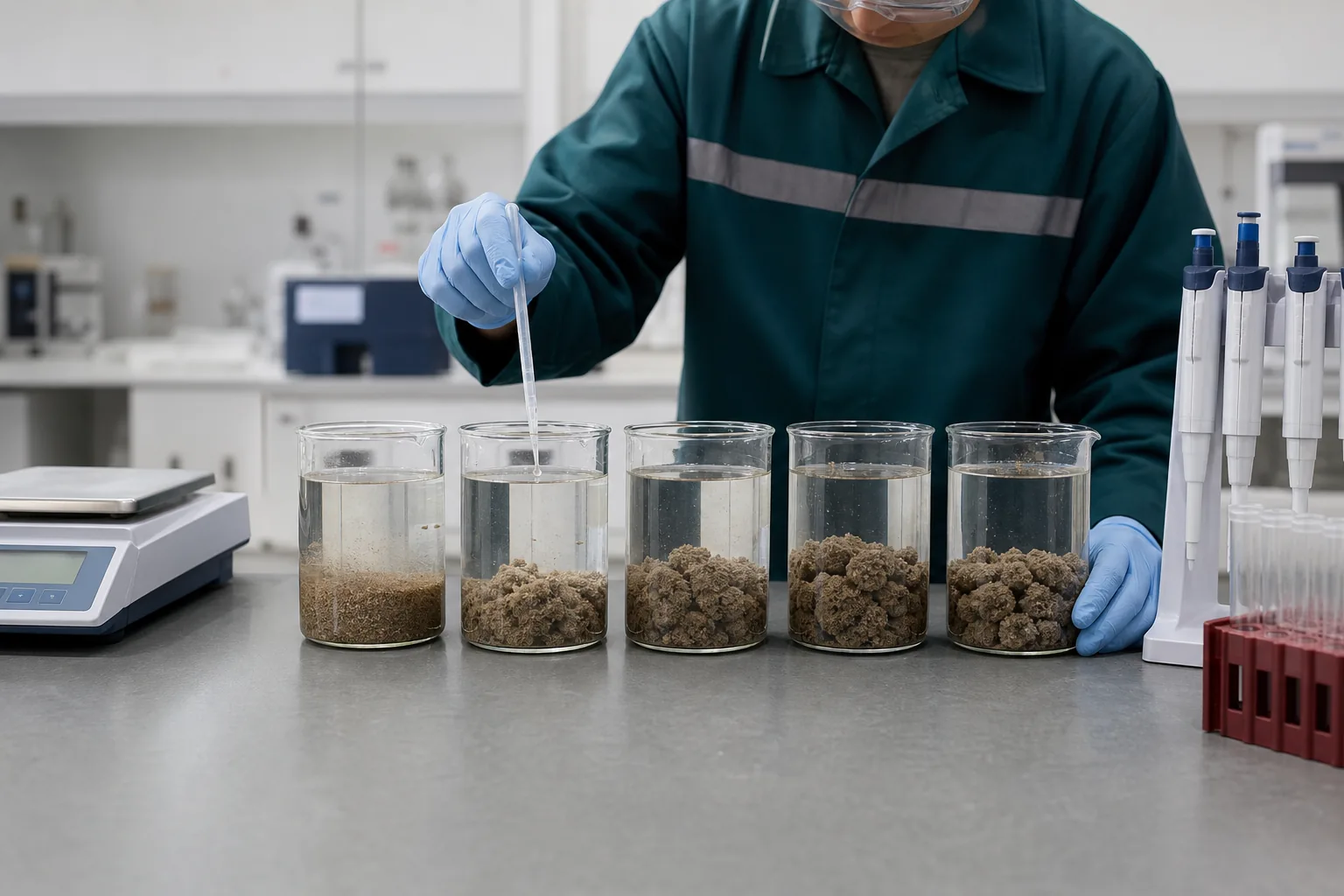
Prepare the candidate according to its supplied instructions. Record concentration, water condition, mixing and solution age. Use representative feed and consistent observation times. Include a baseline or control alongside the candidate.
Test an appropriate range rather than one arbitrarily chosen dose. Watch both the desired endpoint and adverse changes such as poor liquid quality, handling difficulty or unstable response. Do not approve on floc size alone.
Separate screening success from plant approval
A beaker cannot reproduce every pump, transfer and separator condition. A promising candidate should proceed to a bounded plant trial with an agreed stopping rule and stable operating settings.
If the laboratory and plant results disagree, compare preparation, feed timing and injection conditions first. Sample-to-plant troubleshooting helps locate the difference without prematurely rejecting a supplier or raising dose.
Hand over a complete approval record
Retain the product code, sample reference, test data and conditions alongside the proposed commercial limits. Define any outstanding requirement as pending, not implicitly accepted.
Connect approval to packaging and delivery terms and quality evidence. Reorder against the same agreed specification and a documented change-notification process.
Order-specific purchasing records
- Polyacrylamide Factory Price: Active Content vs Commercial Dose — Normalize PAM factory prices with documented active definitions, actual commercial consumption and a common accepted process and delivery boundary.
- Polyacrylamide Factory MOQ: Plan a Useful Trial Order — Discuss PAM sample and trial quantities against plant consumption, observation time, storage and purchase approval instead of assuming a universal MOQ.
- From PAM Factory Sample to First Order: Preserve Grade Identity — Turn an approved polymer trial into a first-shipment specification with code, documents, preparation, packaging and a repeatable receiving comparison.
- Urgent PAM Factory Orders: Verify the Stocked Grade — Check urgent polyacrylamide offers for actual code, lot documents, preparation fit, accepted substitutions and confirmed dispatch scope.