
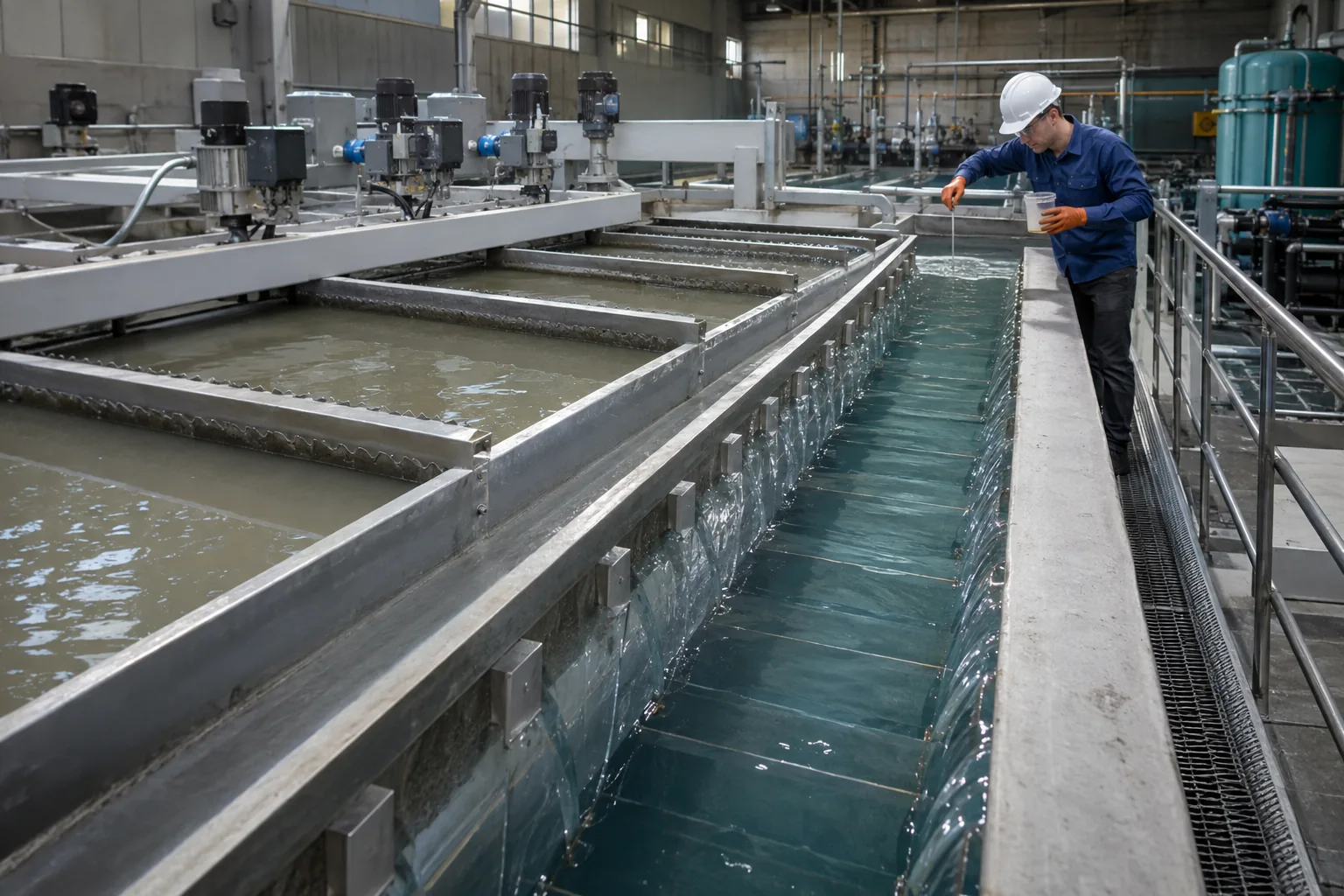
Water clarification: preserve the treatment sequence
Describe the source water, suspended solids, upstream treatment and final separation stage. A jar result is meaningful only when addition sequence and mixing are recorded. Distinguish a change in coagulation from a change in polymer performance.
Measure clarified-water quality at a defined observation time and check whether the floc survives transfer. Do not use visual clarity to claim suitability for drinking-water contact: applicable grade approvals and local requirements need separate confirmation.
Sludge dewatering: consider the whole separator
Identify the sludge blend, dry solids and press or centrifuge arrangement. Compare capture, liquid quality, throughput and cake condition at a stable feed. A drier-looking cake is not a measurement, and improved drainage can conceal higher solids loss.
For cationic candidates, connect product screening with a plant trial at realistic operating settings. Keep upstream treatment and equipment changes visible in the record.
Mineral processing: look beyond settling speed
Record ore or mineral source, particle variability, water reuse and underflow requirements. Fast settling is useful only if the clarified water and thickened solids meet the next process constraint.
Screen anionic candidates and other justified alternatives on fresh representative slurry. Observe bed behavior and handling as well as overflow quality. Archive the sample condition to avoid comparing unlike feeds.
Provide one concise process brief
Include feed source, current product code, preparation method, dose units, separator, operational limitation and target result. Mark missing values as unknown instead of inventing precision.
Use the qualification sequence to decide which candidates merit a larger trial. Send the process brief with the commercial destination so technical and delivery discussions stay aligned.