
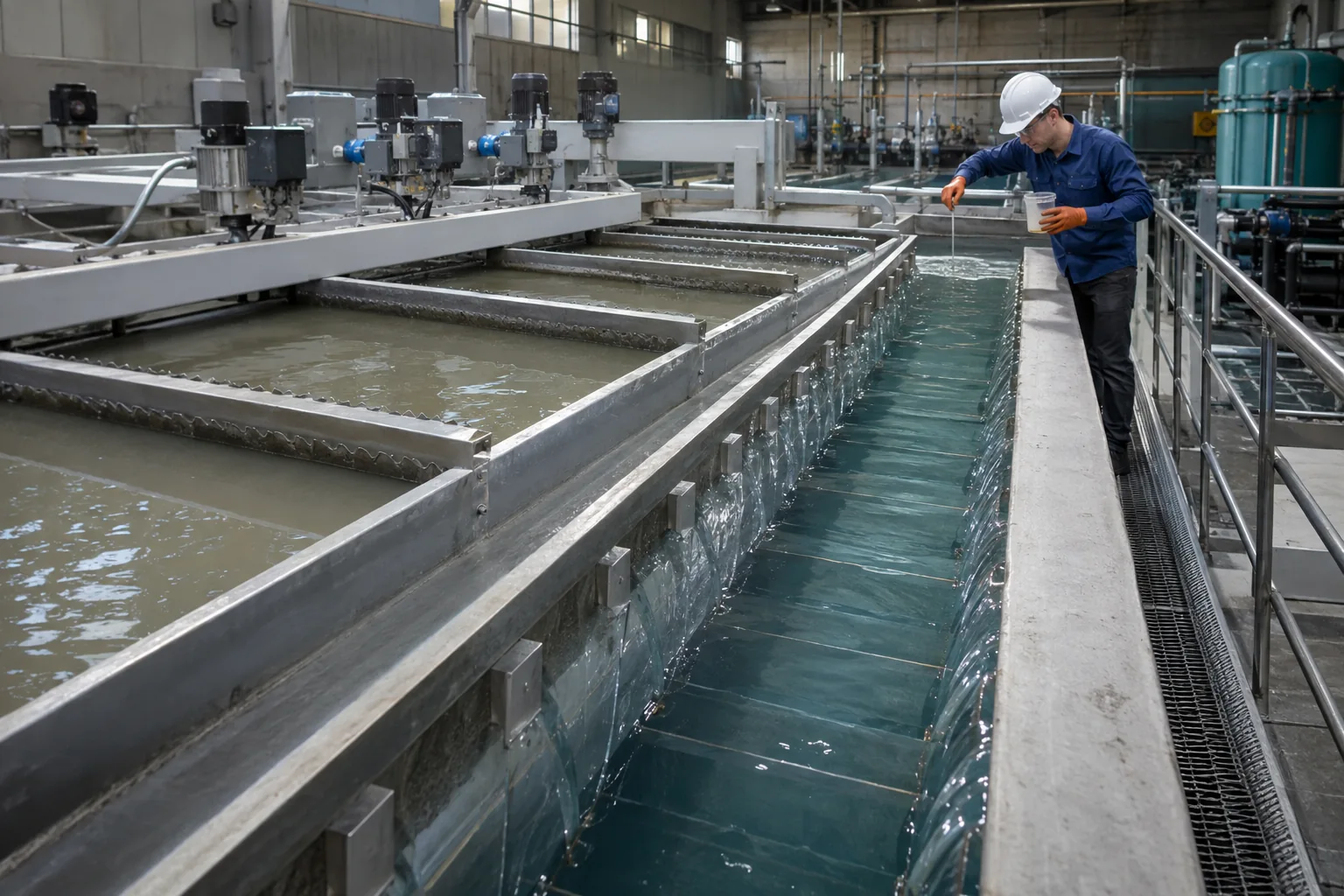
Identify the current sludge
Record biological, primary, digested or chemically precipitated contributions, blend changes, storage age and dry solids. Include pH, conductivity and upstream conditioning where relevant.
Sample the material at polymer contact, preserving fines and a consistent handling method. A favorable test on an unrelated sludge blend is not evidence that the factory has supplied an equivalent grade for the actual plant.
Ask the factory why each code is proposed
Request a small set with explained charge and molecular differences. Confirm commercial form, active definition and the preparation procedure for each candidate.
Compare the incumbent and candidate on a useful dose range. Keep hydration or activation, solution age and delivery calibration controlled. Higher cationicity is not a universal quality ranking and cannot repair an unavailable or poorly prepared stock solution.
Approve both liquid and solid streams
At plant scale, pair centrate solids with representative cake dry solids and dry-solids throughput. Keep approved machine settings and feed conditions recorded while the first chemical comparison is made.
A drier cake that loses more solids may fail the plant's acceptance boundary. Allow residence before sampling, repeat stable intervals and record any coagulant, blend or mechanical change that limits interpretation.
Compare export supply on the qualified basis
Use as-supplied consumption per dry tonne, delivered cost, preparation burden and measured handling consequences. Do not compare solution pump settings or assume active fraction equals liquid density.
The cationic factory-supply route connects conditioning evidence with product identity. Confirm documents, package, destination and the time needed for a controlled first-shipment release.
A centrifuge order record
Retain code, lot, preparation, accepted feed range, useful dose band and paired centrate/cake limits. Estimate the trial material from commercial consumption and a defensible observation period, including transition and repeat checks.
Use the CPAM factory sample request with the equipment and sludge record. Keep benchmark material available for rollback. Do not turn a single successful run into an unconditional supply guarantee for every future sludge or centrifuge setting.
Centrifuge purchase evidence
| Checkpoint | Evidence to retain | Decision boundary |
|---|---|---|
| Sludge identity | Retain sources, blend, age and dry-solids measurements from the actual interval used for comparison. | Results from a different blend need an explicit technical review before becoming a supply acceptance boundary. |
| Product delivery | Keep code, stock preparation, age, calibrated rate and any secondary dilution in the operating record. | A running pump or familiar setting does not prove that the intended commercial polymer mass reached the feed. |
| Paired samples | Keep centrate, representative cake and throughput observations linked to stable approved equipment settings. | A drier isolated cake sample is not a complete improvement if capture or usable throughput became unacceptable. |